Every standard. Every tier. One red line.
Different hazards need different response speeds. We group every standard we monitor into one of three timing tiers — and every reading carries a hazard floor that bypasses the normal ladder.
Different hazards need different response speeds.
Real-time
seconds → minutes
“I need to know now.” Safety-critical. The reading triggers an alert the same minute it arrives.
- Smoke and fire detection
- Water leak → close valve
- CO breach → ventilation + evacuate
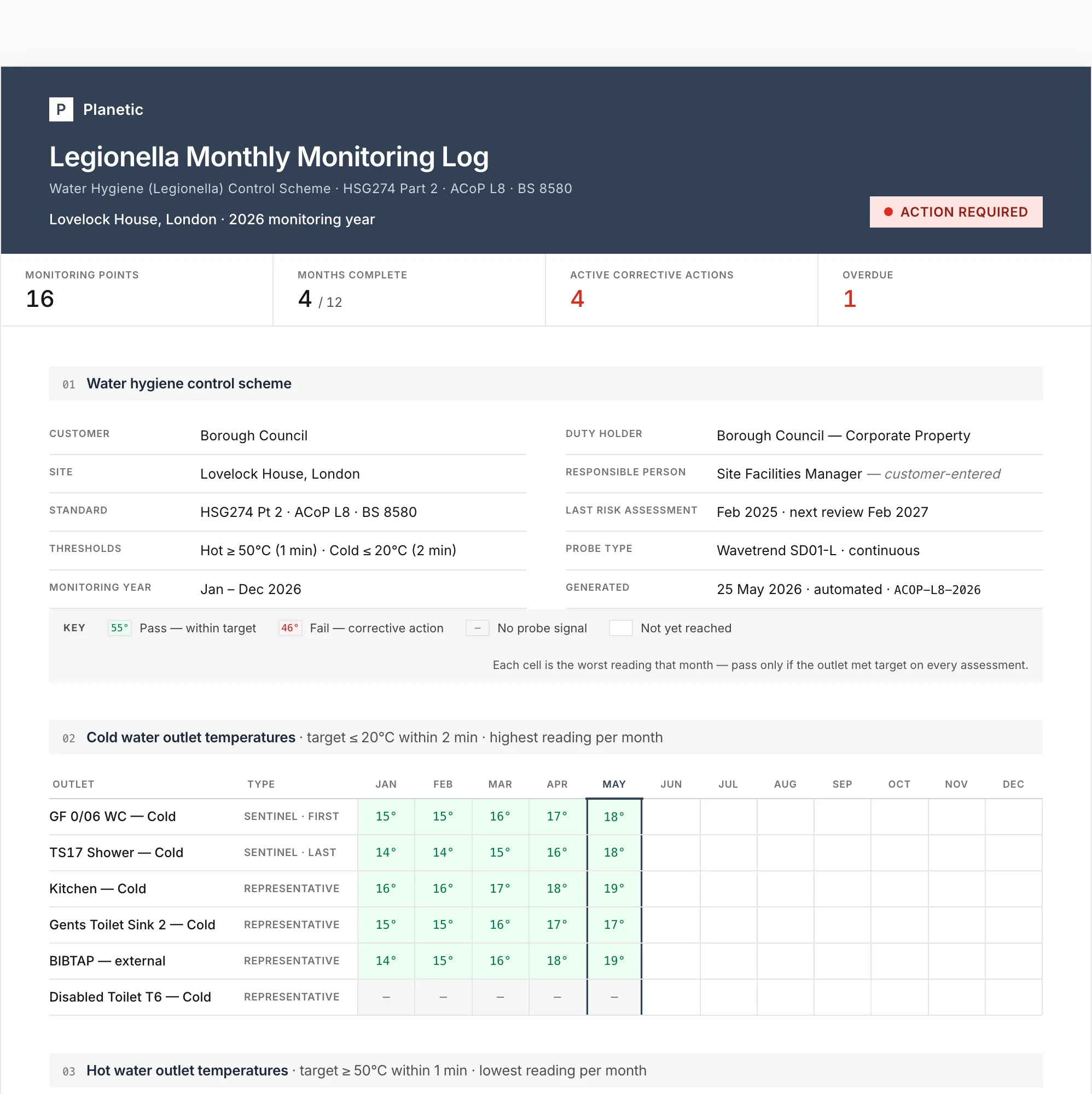
- Legionella temperature dropout
- After-hours motion in a school
Near-time
hours → end of day
“I need to know today.” Operational. FM gets a queue of things to deal with by close of business.
- CO₂ over 1500 ppm sustained > 20 min (BB101)
- Daily pollutant exceedance (PM2.5 / TVOC)
- Classroom under 16°C during teaching hours
- Device offline or low battery
- Cleaning trigger via footfall threshold
Transactional-time
end of month → quarter
“I need it for the report.” Compliance and billing. Rolled up monthly. Audit trail matters more than urgency.
- Water consumption / meter pulse → invoice
- Energy (kWh) → CIBSE TM46 benchmarking
- EPC / DEC operational rating
- WELL v2 / RESET annual compliance report
- SECR carbon disclosure
Standards we support.
Each row is a standard. What we measure for it, how fast we react, and the hazard floor that triggers a critical alert.
| Standard | Enforcement | What we measure | Tier | Hazard floor |
|---|---|---|---|---|
HSG274 Legionella · UK HSE | Statutory Criminal liability, unlimited fines | Water temperature at hot pipe, cold pipe, hot return, calorifier. Flow events. Per-outlet pass/fail. | Real-time | Hot < 50°C sustained · Cold > 20°C sustained · Calorifier < 60°C stored. |
BB101 (2018) School ventilation · DfE | Regulation Ofsted and DfE scrutiny, no direct fines | CO₂, air temperature, humidity per classroom. Natural vs mechanical ventilation rules. | Near-time | CO₂ > 2,500 ppm hazard band · Temp > 35°C or < 5°C absolute floors. |
BB101 — Overheating School thermal comfort · TM52 adaptive | Regulation DfE and Ofsted scrutiny | Air temperature through occupied hours compared to outdoor running-mean (TM52 adaptive model). | Near-time | ≥ 3% of occupied hours over adaptive threshold (TM52 Criterion 1). ≥ 35°C at any time = absolute floor. |
CIBSE TM46 / DEC Energy benchmarking | Operational Cost and benchmarking, not regulator-facing | kWh consumption (electric / gas / heat) per site and zone. Compared against 317-row TM46 benchmark library. | Transactional | Annual kWh/m² above top quartile of CIBSE benchmark = client risk flag. |
Water consumption Meter pulse → invoice | Operational Billing and leak detection | Water meter pulse (litres) per site, per zone if sub-metered. | Transactional | Out-of-hours flow = potential leak — escalates to near-time alerts. |
WELL v2 Wellness certification · IWBI | Voluntary Commercial value, no fines | CO₂ ≤ 1000 ppm, PM2.5 ≤ 15 µg/m³, TVOC ≤ 500, humidity 30–60%, light 250–500 lux, hot water ≥ 51°C. | Near-time | No statutory floor. Failing > 5% of occupied hours = certification jeopardy. |
RESET Air Continuous monitoring cert. | Voluntary Data-quality first cert | CO₂, PM2.5, TVOC, formaldehyde. Data-quality scoring built into the standard. | Real-time | < 80% in-band over 12 months = decertification. |
Fitwel Wellbeing certification | Voluntary Tenant attraction | PM2.5 < 12 µg/m³, CO₂ < 1000 ppm, temp 20–26°C, humidity 30–60%, radon ≤ 4 pCi/L. | Near-time | No statutory floor. Sensor density rule: 1 per 325 m². |
Awaab's Law Damp & mould · social housing | Statutory Landlord liability, court action | Humidity, temperature, mould-risk index, VOC. Triangulated with EPC and vulnerability flag. | Near-time | Mould-risk index in red band beyond statutory window = remediation clock starts. |
HHSRS Housing health & safety | Statutory Local authority enforcement | Subset of 29 hazard categories: damp/mould, excess cold, excess heat, CO, radon, fire, noise, collision. | Near-time | Category 1 score on any monitored hazard = escalation to landlord. |
Martyn's Law Public protection · venue occupancy | Statutory Venue-operator duty of care | Live occupancy count (people counters, motion). Vs max-occupancy zone metadata. | Real-time | Occupancy > max-occupancy for any cap-bearing zone = immediate alert. |
Building Safety Act 2022 Higher-Risk Buildings · fire/structural | Statutory Accountable Person duties · BSR enforcement | Smoke / heat / CO per dwelling. Fire-door state (open/close + propped duration). Structural-stress where instrumented. | Real-time | Any fire/smoke event = evacuate. Fire-door propped > 15 min = compartmentation breach. Sensor offline during an event = liability gap. |
Approved Document F UK Building Regs · Part F · Ventilation | Statutory Non-compliance = enforcement notice or sale block | CO₂ as ventilation proxy, airflow rates per occupant. Dwelling and non-dwelling thresholds differ. | Near-time | CO₂ > 1500 ppm sustained in any occupied zone = Part F ventilation inadequate. |
Approved Document L UK Building Regs · Part L · Energy | Statutory Building Regulations 2010 — new builds and major refurbs | Energy use intensity (kWh/m²/yr), derived CO₂e, fabric performance proxies (∆T indoor/outdoor for heat-loss rate). | Transactional | Operational kWh/m² ≥ 1.5× design target = performance-gap red flag. |
HTM 03-01 NHS Specialised Ventilation · Healthcare | Statutory CQC inspectable for NHS estates | Air changes/hour, pressure differential, temperature, humidity, filter status. OR / isolation / patient-room thresholds differ. | Real-time | Pressure inversion in isolation room (negative → positive) = infection-control breach. |
HTM 04-01 NHS Water Safety · Healthcare | Statutory Companion to HSG274 for NHS estates | Same pipe sensors as HSG274 plus NHS-specific outlet rules and Pseudomonas in augmented-care. | Real-time | Hot < 55°C at augmented-care outlets · Cold > 20°C sustained. |
Cognitive performance Same CO₂ data, different lens | Operational Learning outcomes, not regulator-facing | CO₂ in classrooms interpreted as a productivity and learning metric, not just compliance. | Near-time | No regulatory floor. Cognition drops measurably above 1400 ppm. |
EPC Energy Performance Certificate | Operational MEES: EPC ≥ E to let commercial property | Pulled from the government EPC register. Compared against actual consumption from your meters to surface the gap. | Transactional | EPC below E = letting prohibited under MEES regulations. |
Net Zero / SECR Streamlined Energy & Carbon Reporting | Operational Mandatory disclosure for qualifying UK firms | Energy and derived emissions, aggregated to organisation level for annual SECR filing. | Transactional | Reporting failure = Companies House non-compliance. |
ACOP L8 Legionella · UK HSE Approved Code of Practice | Statutory Approved Code of Practice — near-statutory weight in UK courts | Documents the regime that proves HSG274 compliance: water temperature, flow events, per-outlet pass/fail, written scheme of control. | Real-time | Failure to follow the regime (not the threshold itself) is the legal trigger. Hot < 50°C, cold > 20°C sustained = control failure. |
CIBSE TM52 Overheating · non-domestic buildings | Voluntary Industry-standard adaptive comfort model | Air temperature through occupied hours vs running-mean outdoor temp. Three adaptive criteria across the season. | Near-time | Failing 2 of 3 TM52 criteria over a season = overheating finding. |
CIBSE TM59 Overheating · domestic buildings | Voluntary Industry-standard model for homes, cited in planning | Bedroom and living-room temperature limits during occupied hours. Static thresholds (TM59) plus adaptive (TM52) where relevant. | Near-time | Bedrooms > 26°C for more than 1% of annual sleeping hours = overheating finding. |
Approved Document O UK Building Regs · Part O · Overheating (new homes, 2022) | Statutory Building Regulations 2022 — new residential builds | Internal temperature in new-build homes against simplified or dynamic compliance routes. CO₂ / vent rates as secondary proxies. | Near-time | Sustained exceedance of Part O internal temperature limit = building-control non-conformance. |
Decent Homes Standard Social housing baseline · DLUHC | Statutory Statutory standard for English social housing | Thermal comfort (heating + insulation), HHSRS hazard absence, modern facilities, reasonable repair state. Sensor evidence supports the thermal-comfort and hazard limbs. | Near-time | Failure on any of the four criteria = home is non-decent. Reportable to the Regulator of Social Housing. |
ESOS Energy Savings Opportunity Scheme · UK EA | Statutory Mandatory 4-yearly energy audit for qualifying UK organisations | Total energy consumption across buildings, transport, and processes. Continuous metering data feeds the audit baseline. | Transactional | Missed Phase notification = Environment Agency civil penalty (up to £50k + £500/day). |
Tenant Satisfaction Measures Social housing reporting · Regulator of Social Housing | Regulation Annual statutory return for all registered providers | Stock-condition evidence (damp / mould / hazards / repair times) feeds 22 published TSMs. Sensor data underpins the management-information measures. | Transactional | Failure to submit = regulatory downgrade. Poor results = consumer-regulation intervention. |
What we measureWater temperature at hot pipe, cold pipe, hot return, calorifier. Flow events. Per-outlet pass/fail.
Hazard floorHot < 50°C sustained · Cold > 20°C sustained · Calorifier < 60°C stored.
What we measureCO₂, air temperature, humidity per classroom. Natural vs mechanical ventilation rules.
Hazard floorCO₂ > 2,500 ppm hazard band · Temp > 35°C or < 5°C absolute floors.
What we measureAir temperature through occupied hours compared to outdoor running-mean (TM52 adaptive model).
Hazard floor≥ 3% of occupied hours over adaptive threshold (TM52 Criterion 1). ≥ 35°C at any time = absolute floor.
What we measurekWh consumption (electric / gas / heat) per site and zone. Compared against 317-row TM46 benchmark library.
Hazard floorAnnual kWh/m² above top quartile of CIBSE benchmark = client risk flag.
What we measureWater meter pulse (litres) per site, per zone if sub-metered.
Hazard floorOut-of-hours flow = potential leak — escalates to near-time alerts.
What we measureCO₂ ≤ 1000 ppm, PM2.5 ≤ 15 µg/m³, TVOC ≤ 500, humidity 30–60%, light 250–500 lux, hot water ≥ 51°C.
Hazard floorNo statutory floor. Failing > 5% of occupied hours = certification jeopardy.
What we measureCO₂, PM2.5, TVOC, formaldehyde. Data-quality scoring built into the standard.
Hazard floor< 80% in-band over 12 months = decertification.
What we measurePM2.5 < 12 µg/m³, CO₂ < 1000 ppm, temp 20–26°C, humidity 30–60%, radon ≤ 4 pCi/L.
Hazard floorNo statutory floor. Sensor density rule: 1 per 325 m².
What we measureHumidity, temperature, mould-risk index, VOC. Triangulated with EPC and vulnerability flag.
Hazard floorMould-risk index in red band beyond statutory window = remediation clock starts.
What we measureSubset of 29 hazard categories: damp/mould, excess cold, excess heat, CO, radon, fire, noise, collision.
Hazard floorCategory 1 score on any monitored hazard = escalation to landlord.
What we measureLive occupancy count (people counters, motion). Vs max-occupancy zone metadata.
Hazard floorOccupancy > max-occupancy for any cap-bearing zone = immediate alert.
What we measureSmoke / heat / CO per dwelling. Fire-door state (open/close + propped duration). Structural-stress where instrumented.
Hazard floorAny fire/smoke event = evacuate. Fire-door propped > 15 min = compartmentation breach. Sensor offline during an event = liability gap.
What we measureCO₂ as ventilation proxy, airflow rates per occupant. Dwelling and non-dwelling thresholds differ.
Hazard floorCO₂ > 1500 ppm sustained in any occupied zone = Part F ventilation inadequate.
What we measureEnergy use intensity (kWh/m²/yr), derived CO₂e, fabric performance proxies (∆T indoor/outdoor for heat-loss rate).
Hazard floorOperational kWh/m² ≥ 1.5× design target = performance-gap red flag.
What we measureAir changes/hour, pressure differential, temperature, humidity, filter status. OR / isolation / patient-room thresholds differ.
Hazard floorPressure inversion in isolation room (negative → positive) = infection-control breach.
What we measureSame pipe sensors as HSG274 plus NHS-specific outlet rules and Pseudomonas in augmented-care.
Hazard floorHot < 55°C at augmented-care outlets · Cold > 20°C sustained.
What we measureCO₂ in classrooms interpreted as a productivity and learning metric, not just compliance.
Hazard floorNo regulatory floor. Cognition drops measurably above 1400 ppm.
What we measurePulled from the government EPC register. Compared against actual consumption from your meters to surface the gap.
Hazard floorEPC below E = letting prohibited under MEES regulations.
What we measureEnergy and derived emissions, aggregated to organisation level for annual SECR filing.
Hazard floorReporting failure = Companies House non-compliance.
What we measureDocuments the regime that proves HSG274 compliance: water temperature, flow events, per-outlet pass/fail, written scheme of control.
Hazard floorFailure to follow the regime (not the threshold itself) is the legal trigger. Hot < 50°C, cold > 20°C sustained = control failure.
What we measureAir temperature through occupied hours vs running-mean outdoor temp. Three adaptive criteria across the season.
Hazard floorFailing 2 of 3 TM52 criteria over a season = overheating finding.
What we measureBedroom and living-room temperature limits during occupied hours. Static thresholds (TM59) plus adaptive (TM52) where relevant.
Hazard floorBedrooms > 26°C for more than 1% of annual sleeping hours = overheating finding.
What we measureInternal temperature in new-build homes against simplified or dynamic compliance routes. CO₂ / vent rates as secondary proxies.
Hazard floorSustained exceedance of Part O internal temperature limit = building-control non-conformance.
What we measureThermal comfort (heating + insulation), HHSRS hazard absence, modern facilities, reasonable repair state. Sensor evidence supports the thermal-comfort and hazard limbs.
Hazard floorFailure on any of the four criteria = home is non-decent. Reportable to the Regulator of Social Housing.
What we measureTotal energy consumption across buildings, transport, and processes. Continuous metering data feeds the audit baseline.
Hazard floorMissed Phase notification = Environment Agency civil penalty (up to £50k + £500/day).
What we measureStock-condition evidence (damp / mould / hazards / repair times) feeds 22 published TSMs. Sensor data underpins the management-information measures.
Hazard floorFailure to submit = regulatory downgrade. Poor results = consumer-regulation intervention.
How it shows up day-to-day.
How the red line works.
“Hazard” is the absolute red-line band beyond which a reading is critical. Every metric we measure carries it. It sits above the normal good / alert / alarm ladder and bypasses ordinary thresholds.
Standards, in plain English.
Direct answers to the questions buyers most often Google. No fluff.
What is BB101 and who does it apply to?
BB101 (2018) is the UK Department for Education ventilation and thermal comfort guidance for school buildings. It sets CO₂ thresholds (sustained > 1,500 ppm triggers a daily alert; > 2,500 ppm is the hazard band), temperature ranges, and humidity expectations. It applies to all UK state schools — Ofsted scrutinises against it. Planetic monitors CO₂, temperature, and humidity per classroom against BB101 continuously.
What does Awaab's Law actually require landlords to do?
Awaab's Law sets statutory time limits for social housing landlords to respond to damp and mould hazards once they're notified. The clock starts the moment a hazard is identified — which makes continuous evidence (rather than six-weekly inspections) the difference between knowing on day one and finding out on day forty. Planetic tracks humidity, temperature, and mould-risk index per dwelling so the timestamp is automatic.
Is HSG274 the same as ACOP L8?
Not quite. ACOP L8 is the Approved Code of Practice — it carries near-statutory weight in UK courts. HSG274 is the detailed HSE guidance that explains how to meet L8 in practice. You need to comply with both. Continuous water-temperature monitoring at hot/cold/return/calorifier outlets covers the evidence side for both.
Does continuous sensor monitoring meet HSG274 compliance?
Yes. HSG274 doesn't mandate clipboard log sheets — it requires evidence of temperature control at outlets. Continuous probes (per-outlet, real-time) produce a more defensible audit trail than monthly manual readings: nothing missed, nothing forged, nothing forgotten.
What is the difference between BB101 and Approved Document F?
BB101 is school-specific guidance with prescriptive CO₂ thresholds and ventilation rules. Approved Document F is the wider UK Building Regulations Part F — it covers ventilation requirements for all building types (dwellings, non-dwellings). Schools usually carry both: Part F as statutory baseline, BB101 as sector-specific overlay.
What's a 'hazard floor' and how is it different from a normal alert?
A hazard floor is the absolute red line for any metric — beyond it the reading is critical regardless of usual reporting cadence. It bypasses normal alert ladders and pushes a real-time notification to facilities, plus writes an immutable audit-log entry. Example: CO₂ > 2,500 ppm in a classroom is a BB101 hazard band; even if the metric normally rolls up daily, breaching this triggers immediate escalation.
What's the difference between real-time, near-time, and transactional-time response tiers?
Real-time (seconds → minutes): safety-critical events like fire, water leak, Legionella temperature dropout. Near-time (hours → end of day): operational issues like CO₂ breaches or low classroom temperature that the FM should action by close of business. Transactional-time (month → quarter): compliance and billing — water/energy consumption, annual certifications, regulator submissions. Same sensor data, different response speeds depending on the hazard.
Do you cover HHSRS hazards?
Yes, the subset of the 29 HHSRS hazard categories that map to sensors — damp/mould, excess cold, excess heat, CO, radon, fire, noise, collision/fall. Category 1 scores on monitored hazards trigger escalation to the landlord. Used by local authorities and social housing providers.
Carry a standard we don’t list?
UK building stock carries a long tail of standards. If you’ve got one on your statutory register and we don’t cover it, tell us — odds are someone else has it too.